resources
homepractical tools derived from integrodynamics. this page converts the appendix of part vi: collapse into something anyone can use — without needing a maths background.
the collapse test (plain english)
sometimes a system says: “nothing unusual happened.” but outcomes worsen across multiple domains, in the same direction, after a trigger. the collapse test asks one question:
can all of these events happen due to chance, or is that explanation statistically implausible?
- quantifies how implausible an “innocent explanation” has become
- treats multi-domain patterning as evidence
- produces a reproducible signal you can cite and defend
- prove intent
- assign motive
- replace legal judgment
- turn probability into a moral verdict
who this is for
you can use this method if you are:
- an individual facing coordinated adverse treatment
- a union rep assessing whether a case merits escalation
- a lawyer deciding whether “pattern evidence” exists
- a regulator evaluating systemic failure signals
- an auditor assessing structural drift and governance failure
what you need (minimum inputs)
- a trigger eventgrievance, complaint, whistleblowing, protected disclosure, regulatory inquiry, leadership change, etc.
- domainspay, role, workload, performance ratings, process adherence, access, treatment consistency — any distinct (different) system dimensions.
- directionfor each domain: did it worsen after the trigger? (yes/no)
how to run the test (5 steps)
- define domainslist each independent area of system behaviour you can observe.
- mark outcomesfor each domain: 0 = neutral/improved, 1 = adverse shift.
- count adverse domainslet n be the number of domains that worsened.
- assume innocence (on purpose)give the system every benefit of the doubt: generous probabilities, noise, and correlation.
- compute plausibilityif the probability of the observed multi-domain pattern becomes actuarially negligible, the “benign explanation” collapses.
similar mechanics: the coin flip
imagine flipping a fair coin. heads or tails — either outcome is ordinary. but if you flip the coin ten times and get heads every time, something isn't right. you might still call it chance, but the explanation becomes increasingly implausible the more heads you flip.
two views of the same collapse
most people reason about accumulating outcomes additively: one more adverse shift feels like one more comparable “unit” of evidence. That intuition is linear, and it is usually wrong for probability.
in multi-domain alignment, plausibility does not decrease by addition. it decreases by multiplication. Each additional affected dimension scales down what remains, so the innocent explanation collapses exponentially in ordinary (linear) probability terms.
view 1: collapse in ordinary probability (linear scale)

this is what exponential collapse looks like in the scale people are most familiar with. early steps dominate visually; later steps compress toward zero. that compression does not mean later domains “matter less” — it is a consequence of representing a multiplicative process on a linear axis.
view 2: the correct reasoning scale (log probability)
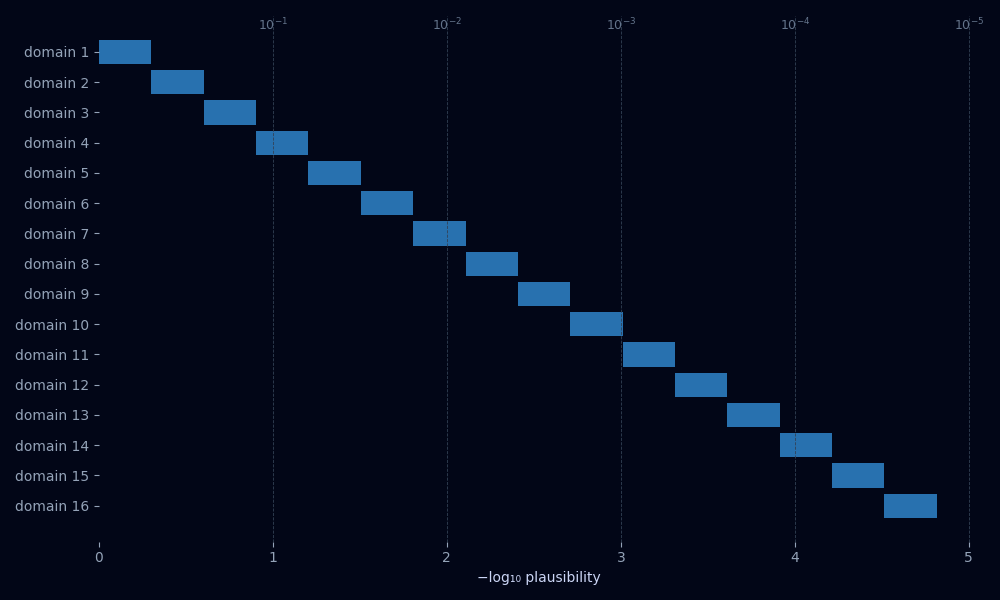
log probability is the correct scale for interpreting multiplicative processes. here, each additional affected dimension produces an equal-sized step because multiplication becomes addition under a logarithm. the boxes are equal in width even though the underlying probability is shrinking rapidly in ordinary terms.
the key point is not that either view is “intuitive”. the key point is that additive human reasoning fails for multiplicative probability. log space is the representation that makes the accumulation law honest.
when many distinct system dimensions move in the same adverse direction, the evidential force comes from dimensionality — not from any single decision.
many domains · same direction · after a trigger · probability collapses exponentially · innocent explanation breaks · escalation becomes rational
how to interpret the result
- keep investigating
- gather more data
- do not overclaim
- the benign narrative is no longer rational
- inaction becomes the higher-risk choice
- escalation is justified
this is a decision-theoretic threshold, not a moral one.
what to do with the result
- attach to grievances
- include in disclosure requests
- use to resist narrative gaslighting
- justify escalation
- trigger structured disclosure
- frame pattern evidence clearly and safely
- frame as probabilistic implausibility, not accusation
- use alongside documents and timelines
- deploy as pattern credibility evidence
- treat collapse as a trigger, not a verdict
- justify audits, supervision, or review
- identify systems requiring intervention
important boundaries
- collapse ≠ guilt
- collapse ≠ intent
- collapse ≠ liability
collapse only means: the random / benign explanation no longer survives probability. proper use is disciplined escalation. misuse is overclaiming.